

| Quick answer: Generative AI is changing software development by helping teams plan, design, code, test, document, modernize, and operate software faster. Its best role is not to replace skilled engineers. It is to support them with rapid drafts, pattern detection, automation, and knowledge access while people keep control of architecture, security, quality, and business decisions. |
Prepared for business leaders, product owners, and technology teams
What Is Generative AI in Software Development?
Generative AI is a type of artificial intelligence that creates new content from instructions and examples. In software work, that content may include user stories, code, test cases, database queries, architecture notes, API documentation, release notes, or troubleshooting steps. A developer may ask an AI assistant to explain an old code module, suggest a function, create test data, or compare two technical options.
How is it different from traditional automation? Traditional automation follows fixed rules. Generative AI works with natural language and patterns learned from large data sets. It can suggest several possible answers, but it does not guarantee that every answer is correct. This is why human review, testing, and governance remain essential.
Why does this matter to business leaders? It can reduce the time between an idea and a working product. It may also help teams make knowledge easier to find, improve routine documentation, and spend more time on customer needs. However, faster code creation is useful only when the team also protects quality, security, privacy, and long-term maintainability.
Why Is Generative AI Changing the Software Development Lifecycle?
Generative AI can support almost every stage of the software development lifecycle, often called the SDLC. The change is larger than autocomplete. AI can connect business goals to technical work, help teams explore options, and provide context while a project moves from discovery to production.
| SDLC stage | How generative AI can help | What people must still own |
|---|---|---|
| Discovery | Summarize interviews, group pain points, draft personas, and find missing questions. | Problem selection, evidence, priorities, and stakeholder agreement. |
| Requirements | Draft user stories, acceptance criteria, process maps, and edge cases. | Accuracy, scope, legal rules, and final approval. |
| Architecture | Compare patterns, outline services, and document decisions. | Trade-offs, scalability, security, cost, and system fit. |
| Development | Suggest code, explain functions, refactor modules, and create examples. | Review, integration, correctness, and maintainability. |
| Testing | Generate test cases, test data, mocks, and regression ideas. | Coverage goals, risk decisions, and final validation. |
| Deployment | Draft pipelines, infrastructure templates, and runbooks. | Access control, environment safety, rollback, and release approval. |
| Operations | Summarize logs, group incidents, and suggest likely causes. | Incident command, production changes, and accountability. |
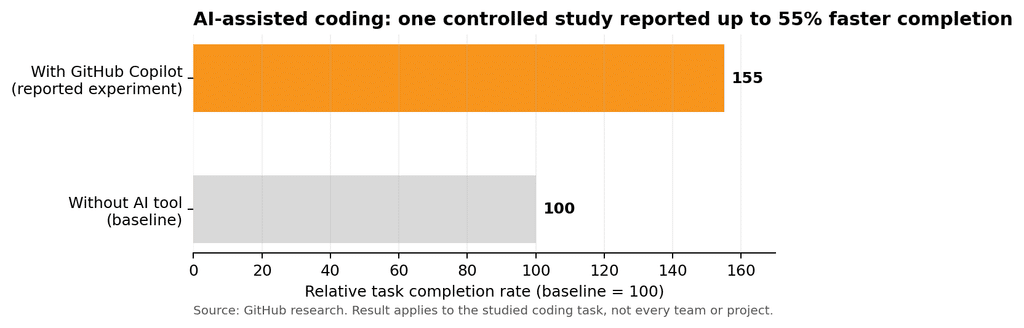
What does current research suggest? GitHub reported that developers completed one controlled coding task up to 55% faster with Copilot. A later GitHub survey found that many developers used saved time for system design, customer solutions, refactoring, and optimization. These results show potential, not a guaranteed return for every organization. Team practices, task type, code quality, and measurement method all affect the outcome.
How Does Generative AI Improve Requirements and Product Discovery?
Clear requirements are one of the strongest predictors of successful delivery. Many projects fail slowly because teams build the wrong feature, miss an important rule, or use different meanings for the same term. Generative AI can help a business analyst turn raw notes into a first draft of structured requirements.
What can AI create during discovery? It can draft user stories, acceptance criteria, interview questions, process steps, risk lists, and feature comparisons. It can also identify vague words such as “fast,” “easy,” or “secure” and ask for measurable definitions. For example, “the page must load fast” may become “the main content should load within an agreed performance target under expected traffic.”
Where should teams be careful? AI cannot know a company’s hidden policy, customer promise, or legal duty unless that context is provided. It may also create a reasonable-sounding rule that is not true. Product owners should therefore treat AI output as a draft to verify with users, subject experts, and project stakeholders.
| Practical use: For custom software development in Bangladesh, a strong discovery process can combine local stakeholder workshops with AI-assisted analysis. This helps teams manage large requirement sets while keeping decisions grounded in the organization’s real operating environment. |
How Does AI Change Software Architecture and System Design?
Generative AI gives architects a fast way to explore design options. A team can describe expected users, data sensitivity, integrations, uptime needs, and growth plans. The AI can then outline possible architectures, explain trade-offs, or draft an architecture decision record.
What can AI not decide alone? It should not make the final choice between a modular monolith, microservices, serverless functions, or another pattern. These choices affect cost, deployment, team structure, data consistency, and future change. An experienced architect must test the recommendation against real constraints.
How can microservices development in Bangladesh benefit? AI can help define service boundaries, draft interface contracts, create event schemas, and document dependencies. Yet teams should avoid splitting a system into too many services. A small product may become harder and more expensive to operate if each feature is turned into a separate service too early.
How Is Generative AI Changing Coding and Code Review?
AI coding tools can generate functions, suggest corrections, explain unfamiliar code, convert code between languages, and draft repetitive parts of an application. They can be especially useful for standard tasks such as data validation, API clients, test fixtures, and documentation comments.
Why is code review still required? Generated code may compile and still be wrong. It may miss an edge case, use an outdated library, weaken authorization, expose a secret, or create a performance problem. Developers should review AI-generated code with the same care as code received from an unknown contributor.
- Ask AI to explain its assumptions before accepting a solution.
- Keep prompts free from passwords, personal data, confidential source code, and client secrets unless an approved private system is used.
- Run formatters, static analysis, dependency checks, unit tests, integration tests, and security scans.
- Require human approval for high-risk areas such as payments, identity, health, public services, and access control.
- Record important architecture and security decisions outside the chat so the team can audit them later.
How Does Generative AI Improve Software Testing and Quality Assurance?
Testing is a strong use case because AI can quickly create variations. From one requirement, it can propose normal cases, boundary cases, failure cases, accessibility checks, and unusual user paths. It can also generate mock data and explain why a test failed.
What is the main limit? AI tends to work from the information it receives. If a requirement is incomplete, its tests may repeat the same gap. Teams need risk-based testing, independent review, and real user validation. AI-generated tests should expand human thinking, not merely confirm AI-generated code.
How can quality improve at scale? Teams can place approved AI tools inside a controlled workflow: draft tests, run them automatically, check code coverage, scan dependencies, test critical APIs, and require a person to review failed or high-risk results. This makes speed and control part of the same process.
How Does AI Support DevOps and Cloud-Native Delivery?
AI can help DevOps teams draft continuous integration and continuous delivery pipelines, infrastructure templates, monitoring queries, deployment checklists, and incident summaries. It can reduce the effort needed to understand a failed build or a large set of logs.
Why is AI cloud-native application development valuable? Cloud-native systems often include containers, managed services, automated deployment, observability, and elastic scaling. AI can help teams navigate this complexity, but it should not receive uncontrolled access to production systems. Changes to infrastructure, permissions, data retention, and network policy need review and approval.
What is a safe operating model? Give the AI the least access needed, separate development from production, protect secrets, keep change logs, test infrastructure in lower environments, and maintain a rollback plan. AI may recommend an action; accountable people should authorize production changes.
How Is AI Powered SaaS Development Becoming Faster and Smarter?
AI powered SaaS development has two meanings. First, teams can use AI to build a SaaS product faster. Second, the product itself can include AI features such as search, summarization, prediction, content generation, or workflow assistance. A company may need one or both.
What should a SaaS platform include beyond the AI feature? A reliable product still needs tenant isolation, identity and access control, billing, audit logs, usage limits, support tools, analytics, backups, and clear data policies. The model is only one part of the product.
How can a Next.js web development company use AI well? AI can help draft reusable components, server actions, API routes, validation rules, tests, and technical documentation. The development team must still check rendering strategy, accessibility, caching, security, browser behavior, performance, and framework version changes.
How Can AI Speed Up MVP Development?
An MVP, or minimum viable product, is the smallest useful product that tests an important business assumption. Generative AI can shorten the early build cycle by helping teams create a prototype, define a small feature set, generate starter code, prepare test data, and analyze user feedback.
What should an AI MVP development company focus on? The main goal is learning, not the amount of code produced. A good team identifies the riskiest assumption, chooses one target user, defines a measurable outcome, and builds only what is needed to test it.
| MVP question | Weak approach | Stronger AI-assisted approach |
|---|---|---|
| What should we build? | Generate a long feature list. | Use research evidence to select one core user problem. |
| How fast should we move? | Ship code as quickly as possible. | Set a short learning cycle with quality and security gates. |
| How should AI be used? | Add a chatbot because AI is popular. | Choose an AI feature only when it improves a real task. |
| How should success be measured? | Count registrations only. | Measure activation, task completion, retention, or validated demand. |
Why may an MVP development company in Bangladesh be a strong partner? Bangladesh offers a growing technology talent base and can support cost-aware product delivery. The best choice, however, should be based on evidence: product discovery skill, engineering quality, communication, security practice, delivery record, and ability to support the product after launch.
How Does AI Improve Mobile App Development?
AI can help mobile teams generate interface drafts, platform-specific code, test cases, localization content, analytics events, and accessibility checks. It may also speed up work across Android, iOS, and cross-platform frameworks.
What should a mobile app development company in Bangladesh protect? Mobile apps handle permissions, identity, device storage, notifications, location, and sometimes payment data. The team must test real devices, weak networks, older operating systems, battery use, offline behavior, secure storage, and app-store requirements. AI cannot replace this field testing.
How Do AI API Integration Services Add Intelligence to Existing Products?
AI API integration services connect an application to an external or privately hosted AI model. This can add document search, classification, summarization, translation, support assistance, data extraction, or natural-language interfaces without training a foundation model from the beginning.
What architecture is usually needed? A secure integration often includes an application layer, prompt templates, retrieval from approved data, output validation, content filtering, monitoring, rate limits, fallback behavior, and an audit trail. Sensitive data should be minimized and protected before it reaches a model.
What can go wrong? A model may return incorrect information, expose sensitive context, follow a malicious instruction, or produce unsafe output. OWASP identifies prompt injection as a major risk for large language model applications. This happens when crafted input changes the model’s behavior in an unintended way. Input controls alone are not enough; teams also need strict permissions, output checks, system boundaries, and monitoring.
How Can AI Modernize Legacy Systems?
AI legacy system modernization can help teams understand software that has limited documentation or depends on older technology. AI can summarize modules, map dependencies, explain database queries, draft tests around current behavior, and suggest a staged migration plan.
Why should modernization happen in stages? A full rewrite can remove useful business rules by accident. A safer path is to discover the system, establish tests, separate high-value functions, introduce APIs, move selected workloads, and compare old and new results. This reduces risk while the organization continues to operate.
- Inventory applications, users, data, dependencies, costs, and known risks.
- Document critical business rules and create tests around current behavior.
- Choose a modernization path: retain, rehost, replatform, refactor, replace, or retire.
- Expose stable functions through APIs when this reduces coupling.
- Move in small releases and observe performance, errors, and user impact.
- Retire old parts only after data, controls, and recovery plans are verified.
What Benefits Can Enterprises Expect?
Enterprise software development in Bangladesh and other delivery markets can benefit from faster analysis, more consistent documentation, broader test coverage, and quicker onboarding. AI can also help experienced engineers spend less time on repetitive tasks and more time on architecture, customer problems, and risk reduction.
| Potential benefit | How to measure it | Important caution |
|---|---|---|
| Faster delivery | Lead time, cycle time, release frequency. | Do not count code volume as business value. |
| Better quality | Escaped defects, rework, test coverage, incident rate. | More generated tests do not always mean better tests. |
| Improved developer experience | Time on deep work, onboarding time, team survey. | Tool adoption alone does not prove value. |
| Lower support effort | Resolution time, repeat incidents, self-service success. | Incorrect AI answers can increase risk. |
| Faster modernization | Modules understood, dependencies mapped, migration milestones. | Validate AI explanations against the running system. |
What does DORA research add? DORA has described generative AI as an amplifier: it can strengthen capable organizations but also magnify weak processes. Earlier DORA findings showed gains in individual productivity and satisfaction alongside delivery trade-offs. The lesson is simple: AI works best with small batches, strong testing, clear platforms, fast feedback, and healthy engineering practices.
What Risks Must Organizations Manage?
The main risks include inaccurate output, insecure code, confidential data exposure, copyright or license questions, model and vendor dependency, hidden bias, weak audit trails, and overreliance by staff. AI features may also face prompt injection, sensitive information disclosure, unsafe output handling, and excessive permissions.
How should leaders respond? NIST’s Generative AI Profile extends its AI Risk Management Framework and supports a lifecycle approach to trustworthiness. A practical program should govern how AI is selected, map where it is used, measure performance and risk, and manage problems through controls and review.
| Risk | Useful control |
|---|---|
| Incorrect or invented output | Ground answers in approved sources, show citations, test against known cases, and allow human review. |
| Sensitive data exposure | Classify data, minimize prompts, use approved environments, encrypt data, and block secrets. |
| Insecure generated code | Use peer review, static analysis, dependency scanning, security testing, and protected branches. |
| Prompt injection | Separate instructions from untrusted content, limit tools and permissions, validate output, and monitor abuse. |
| Vendor lock-in | Use an abstraction layer, track model-specific behavior, export logs, and maintain fallback options. |
| Unclear accountability | Assign owners for product, model, data, security, and incident response. |
How Should a Business Choose an AI Software Development Partner?
A partner should understand both software engineering and responsible AI delivery. A company that only demonstrates a chatbot may not be ready to build a secure enterprise system. Ask for evidence across product discovery, architecture, data protection, testing, cloud delivery, monitoring, and support.
What should buyers look for in AI custom software development services? The provider should explain when AI is useful, when a normal rule-based system is better, how data will flow, which model will be used, how outputs will be evaluated, and what happens when the model fails.
- Relevant case studies with measurable business outcomes, not only technical demos.
- A clear discovery process and written acceptance criteria.
- Secure AI API integration, data controls, and role-based access.
- Experience with web, mobile, SaaS, cloud-native, microservices, and legacy environments.
- Automated testing, code review, deployment controls, monitoring, and incident response.
- Transparent ownership of source code, prompts, data, documentation, and intellectual property.
- A plan for cost monitoring, model changes, ongoing evaluation, and post-launch support.
Why consider a custom software development Bangladesh partner? The right Bangladesh team can combine engineering skill, regional understanding, global delivery experience, and cost efficiency. Buyers should compare capabilities rather than price alone. Strong communication, governance, security, and long-term support create more value than the lowest initial estimate.
How Should an Organization Start Its AI Adoption Roadmap?
Start with a small, valuable, measurable use case. Avoid launching many tools before the organization knows what success means. Choose a workflow where people already spend time reading, drafting, searching, testing, or classifying information.
- Define the business problem and the user who experiences it.
- Set a baseline for time, quality, cost, risk, and user satisfaction.
- Classify the data and decide what may or may not be sent to an AI system.
- Select a model and architecture based on accuracy, privacy, latency, cost, and control.
- Build a small pilot with human review and clear fallback behavior.
- Evaluate output quality with a fixed set of real examples and edge cases.
- Run security, privacy, accessibility, and performance checks.
- Measure business impact, collect user feedback, and improve the workflow.
- Scale only after controls, ownership, documentation, and support are ready.
| Recommended principle: Use AI to make a good engineering system better. If requirements, tests, ownership, or deployment controls are weak, repair those foundations as part of the AI program. |
What Does the Future of AI-Assisted Software Development Look Like?
Software teams are moving from simple code suggestions toward AI agents that can work across several steps. An agent may read a ticket, inspect a repository, propose changes, run tests, and prepare a draft pull request. This can improve flow, but greater autonomy also creates greater risk. Permissions, review gates, test environments, and detailed logs become more important as tools take more actions.
Will AI replace developers? The stronger near-term view is that roles will change. Developers will spend more time defining problems, reviewing systems, managing risk, designing experiences, and connecting technology to business outcomes. Basic code generation may become easier, while architecture, security, data judgment, communication, and domain knowledge become more valuable.
What should organizations do now? Build practical experience without giving up engineering discipline. Train teams, create approved use cases, measure results, protect sensitive information, and improve the development platform. The winners will not be the companies that generate the most code. They will be the companies that turn reliable software into useful outcomes faster.
What Is the Final Takeaway?
Generative AI is transforming modern software development across discovery, requirements, architecture, coding, testing, deployment, operations, SaaS products, mobile apps, APIs, cloud-native systems, microservices, and legacy modernization. It can shorten feedback cycles and help teams make better use of their time.
The opportunity is real, but so is the need for control. AI output must be reviewed, tested, secured, measured, and connected to a clear business goal. Organizations that combine AI with skilled people, strong engineering practices, and responsible governance can create software that is faster to deliver and safer to trust.
For organizations seeking AI custom software development services, the best first step is a focused discovery session. Define the problem, study the users, assess the data, choose a measurable pilot, and build an architecture that can grow. That approach turns generative AI from a trend into a practical business capability.