

Quick answer: Choose a software development partner that understands your business outcome, proves relevant delivery experience, follows secure engineering practices, communicates clearly, and can support the product after launch. Compare evidence through a structured scorecard, reference checks, a technical workshop, and a small paid discovery phase before making a large commitment.
Prepared for business leaders, product owners, procurement teams, and technology decision-makers
What Should a Digital Transformation Partner Actually Do?
What is the partner’s main job? A strong partner turns a business goal into a secure, usable, and maintainable digital product. The work may include discovery, process redesign, user research, software architecture, development, testing, cloud deployment, data migration, training, and ongoing support. The partner should help you improve the way the organization works, not only replace a paper form with a screen.
Why does the word “partner” matter? A vendor may wait for instructions and deliver tasks. A true partner asks hard questions, explains trade-offs, protects the project from avoidable risk, and takes responsibility for outcomes within its control. It should tell you when a requested feature adds little value or creates unnecessary cost.
How does a custom software development company add value? It designs around your users, workflows, data, policies, integrations, and goals. This differs from forcing the organization into a standard product that may not fit. Good custom application development services still reuse proven components and platforms when that reduces cost and risk.
Why Is Choosing the Right Software Development Company Difficult?
Why do many providers look similar during a sales process? Most websites mention agile delivery, cloud technology, skilled developers, security, and quality. These claims are easy to make and hard to compare. Buyers need evidence that connects each claim to a real project, process, person, document, or measurable result.
What makes digital transformation especially risky? The project often changes several things at once: technology, user behavior, business processes, data, roles, and policy. A team may write good code and still fail if it does not understand adoption, governance, integration, or operating constraints.
How should price be viewed? The lowest proposal may exclude discovery, testing, security, documentation, deployment, data migration, or post-launch support. The highest proposal is not automatically the best either. Compare total value, assumptions, included work, ownership, risks, and likely lifetime cost.
How Should You Define the Project Before Searching for a Partner?
What problem are you trying to solve? Start with the user, the current difficulty, the desired result, and the evidence that the problem matters. Avoid beginning with a fixed technology unless a real constraint requires it. “We need a mobile app” is a solution statement; “field officers cannot complete inspections offline” is a problem statement.
Which outcomes should be measurable? Define a small set of business measures such as processing time, error rate, service adoption, completion rate, operating cost, revenue, customer satisfaction, or employee effort. These measures help the partner make better design choices and help you judge success after launch.
What information should be ready? Provide target users, major workflows, data sources, security needs, integrations, expected scale, budget range, timeline, decision owners, compliance duties, and known constraints. When some answers are unknown, ask the partner to include discovery rather than inventing certainty.
| Project input | Useful question | Why it matters |
|---|---|---|
| Business outcome | What must improve for users or the organization? | Keeps delivery tied to value. |
| Users and workflows | Who will use the system, where, and under what conditions? | Shapes design, access, and testing. |
| Data and integrations | Which systems exchange data, and who owns each source? | Reveals complexity and dependencies. |
| Risk and compliance | Which data, laws, policies, and service duties apply? | Sets security and governance needs. |
| Scale and operations | How many users, transactions, regions, and support hours are expected? | Guides architecture and cost. |
Which Type of Software Partner Fits Your Project?
Which partner fits a unique workflow? A custom software solutions provider is useful when your process, integration needs, citizen service, competitive advantage, or data model cannot be met well by an off-the-shelf tool. The partner should still test whether configuration, integration, low-code, or an existing platform can solve part of the need.
When does offshore custom software development make sense? It can expand the talent pool and improve cost efficiency, especially for long-term product teams. It works best when governance, documentation, working hours, communication rules, security controls, and decision rights are clear. Distance is manageable; unclear ownership is not.
Why consider custom software development Bangladesh? Bangladesh can offer capable engineers, competitive delivery costs, and experience serving international organizations. The selection standard should remain global: verify technical leadership, English communication, delivery governance, security, business continuity, references, and long-term support.
| Project need | Partner profile to seek | Evidence to request |
|---|---|---|
| Complex internal or public platform | Enterprise software development company | Architecture examples, security program, integration record, support model. |
| Subscription software product | SaaS product development company | Multi-tenancy, billing, observability, product analytics, DevOps. |
| New idea that needs validation | MVP software development company | Discovery method, prototype examples, experiment metrics, learning plan. |
| Customer or operational web system | Web application development company | Responsive UX, accessibility, performance, testing, API experience. |
| Connected systems and data | API development company | API security, contracts, monitoring, versioning, documentation. |
| Cloud-scale transformation | Cloud-native delivery partner | Containers, automation, reliability, FinOps, recovery, observability. |
How Should You Evaluate Enterprise Software Capability?
What should an enterprise software development company understand? It should be comfortable with many users, complex permissions, large data sets, audit requirements, integrations, availability targets, and change across departments. Enterprise application development services should include business analysis, architecture, quality assurance, security, deployment, documentation, and support.
Why does architecture matter? Enterprise software architecture consulting should show how the partner handles identity, data ownership, integration boundaries, scalability, reliability, recovery, observability, and future change. Ask for a simple diagram and decision record, not a wall of fashionable technical terms.
When is a large-scale software development company necessary? Large programs may need several teams, formal governance, release coordination, service management, and multi-region operations. Ask how the company manages dependencies, shared standards, environments, automated testing, and decisions across teams.
How can an enterprise mobile app development company prove readiness? It should demonstrate secure device storage, offline use, weak-network behavior, identity, accessibility, privacy, mobile testing, app-store release, and support across device versions. For internal enterprise apps, device management and role controls may also matter.
Where can low-code enterprise app development help? Low-code can speed up forms, workflows, approvals, dashboards, and internal tools. Ask about licensing, vendor lock-in, performance limits, source control, testing, integration, security, and exit options before making it a core platform.
Why consider enterprise software development Bangladesh? A qualified partner in Bangladesh may combine large-program delivery experience with cost efficiency. Ask for evidence from government, global institution, regulated, or high-scale projects that match your risk level rather than accepting a broad company profile.
How Should You Evaluate SaaS Product Development Capability?
What should a SaaS development company deliver beyond features? It should design tenant isolation, user roles, onboarding, subscriptions, usage limits, billing, support, analytics, backups, monitoring, and secure operations. The product must be easy to improve after launch, not only easy to demonstrate.
Which evidence should a SaaS product development company provide? Ask for examples of products that reached real users, how the team measured activation and retention, how releases were managed, and how customer data was separated. A B2B SaaS product development company should also understand organization accounts, admin controls, audit logs, integrations, contracts, and service expectations.
Why may you need a cloud-native SaaS development company? Cloud-native patterns can support frequent releases, scaling, resilience, and managed services. They can also increase complexity. The partner should explain why each service is needed and how it controls cost, reliability, data, and operational risk.
How do SaaS DevOps engineering services affect long-term performance? Strong DevOps connects code review, automated tests, security checks, infrastructure, deployment, monitoring, and rollback. Ask to see a sample pipeline, environment strategy, incident process, service-level measures, and ownership after launch.
Why compare a SaaS development company Bangladesh with global alternatives? Compare product thinking, architecture, communication, security, DevOps maturity, commercial model, and support coverage. Location and price are factors, but they should not replace proof of product outcomes and operational discipline.
How Should Startups and MVP Buyers Evaluate a Partner?
What does custom software development for startups require? Startups need speed, but they also need learning. The team should help identify the riskiest assumption, choose a narrow user group, define a success measure, and avoid spending the budget on features that do not test demand.
What should a startup MVP development company or MVP app development company demonstrate? Ask for examples of prototypes, user tests, early releases, analytics, and decisions made from feedback. Rapid MVP prototyping services should create learning quickly, while lean MVP development services should remove work that does not support the key test.
Which MVP specialist fits the product? A web app MVP development company may fit browser-based workflows, while an AI MVP development company should also explain model accuracy, data use, evaluation, fallback behavior, and cost. A fintech MVP development company must understand identity, transactions, fraud, audit, and regulation. Healthcare MVP development services must address sensitive data, clinical risk, consent, accessibility, and relevant compliance from the start.
When should you hire custom software developers directly? Direct hiring may suit a company with strong internal product leadership, architecture, delivery management, and quality systems. If those functions are missing, hiring individuals without a clear operating model can create more coordination risk than hiring a complete product team.
How Should You Evaluate Web Application Development Capability?
What should custom web application development include? It should cover user experience, frontend and backend engineering, data, APIs, security, accessibility, performance, analytics, testing, deployment, and support. Good web app development services should work well on common devices and networks, not only on the developer’s laptop.
Which web partner fits the technical scope? A full stack web development company can manage the browser, server, database, and integrations. A progressive web app development company may be useful when users need install-like behavior, offline support, notifications, or improved mobile access without separate native apps.
When does web application development outsourcing work well? It works when product ownership, priorities, acceptance criteria, communication, access, environments, and quality gates are clear. Ask how the partner will transfer knowledge and prevent your organization from becoming dependent on undocumented code.
Why consider a web app development company Bangladesh? Bangladesh partners may offer strong full-stack talent and cost value. Check live application quality, Core Web Vitals or comparable performance evidence, accessibility practice, secure coding, automated tests, cloud deployment, and maintenance response.
What specialist web experience may matter? A B2B web portal development company should understand organizations, roles, approvals, documents, reporting, and integrations. E-commerce web application development also requires catalog, checkout, payment, inventory, promotion, performance, fraud, analytics, and peak-load planning.
How Should You Evaluate API and Integration Capability?
What should REST API development services include? A strong partner defines resources, contracts, errors, authentication, authorization, versioning, rate limits, testing, documentation, and lifecycle ownership. Custom API development services should solve a clear integration or product need rather than add another technical layer without purpose.
How should an API integration company protect connected systems? It should use least privilege, secret management, encryption, input validation, audit logging, retry controls, timeout rules, and safe failure behavior. Ask how data is mapped, how duplicate events are handled, and who responds when an external service changes.
When are AI API integration services different? AI outputs may vary or be wrong, so the design needs evaluation, grounding, output checks, privacy controls, cost limits, monitoring, and fallback behavior. The partner should explain how it protects sensitive context and limits what the model can do.
Why assess API development and integration Bangladesh providers with the same global controls? Integrations carry business-critical data across boundaries. Ask for API specifications, automated contract tests, threat modeling, deployment controls, API monitoring and management services, support procedures, and examples of stable production integrations.
How Should You Evaluate Cloud-Native and Multi-Tenant Capability?
What should multi-tenant microservices development solve? It may help separate domains, scale busy services, and release parts independently. It also adds network, data, testing, deployment, and observability complexity. Ask the partner to justify service boundaries and explain how tenant data remains isolated.
What should a multi-tenant app development company Bangladesh demonstrate? It should show tenant-aware identity, data isolation, configuration, usage tracking, billing support, backups, incident handling, and automated testing. It should also explain how one tenant’s heavy use or failure is prevented from harming others.
How does AI cloud-native application development change the risk? AI services add model access, prompt and retrieval layers, evaluation, variable cost, latency, content risk, and new security concerns. The architecture should limit permissions, log important actions, validate output, and provide a safe non-AI path when needed.
When is a multi-cloud application development company useful? Multi-cloud may support regulatory, resilience, customer, or acquisition needs, but it often increases cost and complexity. Ask whether the benefit is real and how identity, data, networking, monitoring, deployment, and staff skills will remain consistent.
Why ask about cloud-native cost optimization services before launch? Architecture choices affect ongoing spend. The partner should estimate major cost drivers, set budgets and alerts, right-size services, manage storage and data transfer, and review cost per user or transaction as the product grows.
What Evidence Should You Request Before Shortlisting?
What proves relevant experience? Request two or three case studies that match your project in scale, risk, users, integration, or operating model. Ask what problem was solved, what the partner owned, what changed after launch, what went wrong, and what the team learned.
Who should you meet? Meet the proposed product lead, architect, engineering lead, quality lead, security contact, and delivery manager when those roles matter. A strong sales presentation is not proof that the delivery team has the same skill.
How can references reduce risk? Speak with recent clients whose projects are similar. Ask about communication, estimates, change control, quality, incidents, staff continuity, documentation, and support after launch. Also ask whether the client would choose the partner again.
- What live products or anonymized technical artifacts can the partner show?
- How were users involved in discovery and testing?
- Which measurable outcomes improved after launch?
- What difficult delivery problem did the team face, and how was it resolved?
- How much of the work was completed by the proposed company and team?
- What documentation, code, infrastructure, and knowledge were transferred to the client?
How Should You Assess Engineering Quality and Security?
How should quality appear in the delivery process? Look for peer review, coding standards, automated tests, acceptance tests, performance checks, dependency management, protected branches, controlled releases, monitoring, and defect learning. Quality should be built into each release, not added during the final week.
What security evidence is useful? Ask how the partner follows secure development practices, protects secrets, manages access, scans dependencies, handles vulnerabilities, separates environments, records changes, and responds to incidents. NIST’s Secure Software Development Framework gives buyers and suppliers a common language for discussing secure development outcomes.
Which application standards may help? OWASP ASVS can guide web application security verification, while OWASP MASVS supports mobile application security. Standards are not certificates of perfection. They are useful when the partner can show how relevant controls become requirements, tests, evidence, and release decisions.
| Security buying rule: Do not accept “we follow best practices” as the final answer. Ask which practices apply, who owns them, when they happen, what evidence is produced, and how exceptions are approved. |
How Should You Evaluate Delivery, Communication, and Culture?
How will the partner make progress visible? Strong teams use a shared backlog, clear priorities, short delivery cycles, demonstrations, decision logs, risk tracking, and working software. Status reports should explain outcomes, blockers, decisions, and next steps rather than only list completed tasks.
What communication rhythm is enough? Agree on daily working contact, weekly progress review, product demonstrations, steering decisions, incident channels, and escalation paths. Offshore delivery can work very well when overlap hours, response expectations, written records, and decision owners are clear.
Why does culture matter? Digital transformation includes uncertainty. The partner needs enough confidence to challenge weak assumptions and enough humility to learn from users and domain experts. Look for clear language, respectful disagreement, early warning, and honest discussion of limits.
How Should You Compare Pricing and Commercial Models?
What does a fixed-price model suit? It can work for a small, well-defined scope with stable requirements and clear acceptance rules. It becomes risky when discovery is incomplete, because suppliers may add contingency, restrict change, or protect margin by reducing quality.
When does a time-and-materials model fit? It supports learning and changing priorities, especially for product development. It needs strong product ownership, transparent rates, visible capacity, frequent delivery, budget limits, and measures of value. Paying for time should not mean accepting unclear output.
How should you compare total cost? Include discovery, design, development, licenses, cloud services, security, data migration, testing, deployment, training, support, enhancements, vendor dependencies, and exit costs. Ask every bidder to state assumptions and exclusions in the same format.
| Commercial area | Question to ask | Risk if unclear |
|---|---|---|
| Scope | What is included, excluded, and assumed? | Change disputes and surprise cost. |
| Team | Which named roles and seniority are priced? | A weaker team than the sales proposal. |
| Quality | Which testing, security, and documentation activities are included? | Cheap build followed by expensive repair. |
| Operations | Who owns cloud, monitoring, incidents, and support? | No clear owner after launch. |
| Exit | How are code, data, credentials, and knowledge transferred? | Vendor lock-in and business disruption. |
How Can a Weighted Scorecard Improve the Decision?
Why use a scorecard? It prevents the loudest presentation or lowest price from controlling the decision. A scorecard also helps business, technology, security, procurement, and user representatives discuss the same evidence.
How should scoring work? Define criteria and weights before final proposals. Score each provider from one to five, record the evidence, and discuss large differences between reviewers. Keep mandatory conditions separate; a provider should not win through a high total score if it fails a critical security or legal requirement.
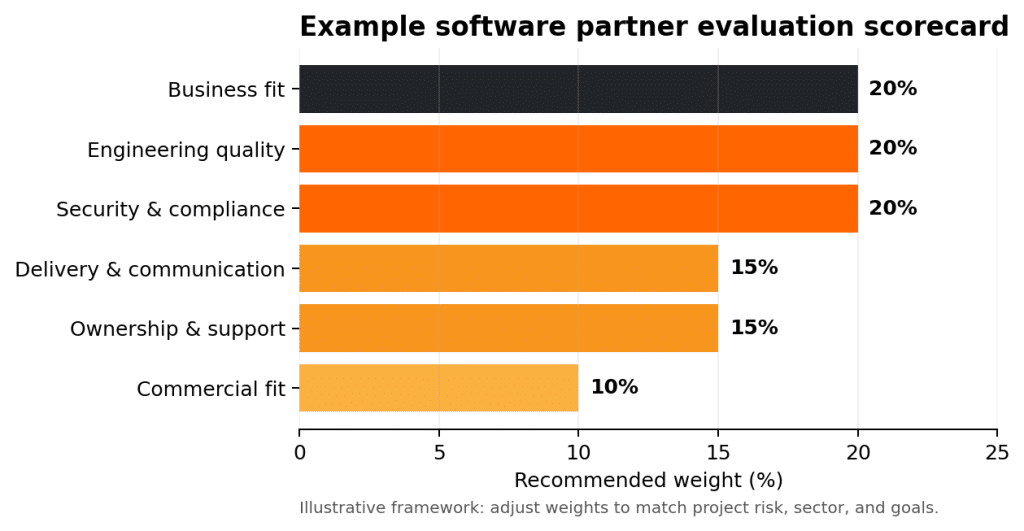
| Criterion | Example weight | What strong evidence looks like |
|---|---|---|
| Business and user fit | 20% | Clear problem framing, domain questions, adoption approach. |
| Engineering quality | 20% | Architecture reasoning, testing, maintainability, delivery artifacts. |
| Security and compliance | 20% | Secure SDLC, access control, evidence, incident readiness. |
| Delivery and communication | 15% | Named team, transparent process, demos, risk escalation. |
| Ownership and support | 15% | Documentation, knowledge transfer, SLAs, exit plan. |
| Commercial fit | 10% | Clear assumptions, total cost, fair change model. |
Which Contract Terms Protect the Project?
What should the statement of work define? It should cover outcomes, scope, deliverables, milestones, roles, assumptions, acceptance, environments, security, data handling, dependencies, reporting, change control, and support. Ambiguous promises should be converted into testable conditions where possible.
Who should own intellectual property and access? The contract should clearly define ownership or licensing for source code, designs, prompts, models, data, configurations, infrastructure, documentation, and third-party components. Your organization should control critical accounts, domains, repositories, cloud access, and production credentials.
How should continuity be protected? Include staff replacement rules, knowledge transfer, documentation duties, backup and recovery responsibilities, incident notification, subcontractor disclosure, termination support, data return, deletion evidence, and a practical exit plan.
What Red Flags Should Stop or Slow the Buying Process?
- What red flag appears when the provider promises a final price before understanding users, data, integrations, and risk?
- What red flag appears when every problem is answered with the same technology or platform?
- What red flag appears when you cannot meet the proposed delivery leaders?
- What red flag appears when security answers remain general and no evidence is available?
- What red flag appears when the proposal has many features but no measurable business outcome?
- What red flag appears when code ownership, cloud accounts, data use, or exit rights are unclear?
- What red flag appears when the provider avoids discussing failed projects, incidents, or lessons?
- What red flag appears when communication is slow or confusing during the sales stage?
- What red flag appears when a low price depends on missing testing, documentation, or support?
- What red flag appears when references cannot confirm the provider’s stated role and results?
How Should You Run a Low-Risk Final Selection Process?
- How can you align stakeholders? Agree on outcomes, mandatory requirements, budget range, risks, evaluation criteria, and decision owners.
- How can you create a fair shortlist? Compare providers with relevant scale, domain, technology, security, and operating experience.
- How can you test thinking? Run the same paid or time-boxed discovery workshop with finalists and compare questions, reasoning, clarity, and outputs.
- How can you verify claims? Review technical artifacts, meet the actual team, check references, and validate security and commercial assumptions.
- How can you test collaboration? Use a small pilot or discovery phase with real stakeholders, data constraints, and acceptance criteria.
- How can you make the decision? Score evidence, document trade-offs, resolve mandatory gaps, negotiate clear terms, and keep a backup option.
| Final decision principle: Choose the team you trust to handle uncertainty openly, not the team that pretends uncertainty does not exist. |
What Is the Final Takeaway?
What makes the right software development partner? The right partner connects business value, user needs, architecture, security, quality, delivery, and operations. It shows evidence, communicates clearly, and accepts responsibility for building a product your organization can understand, operate, and improve.
Why should buyers avoid choosing on price alone? Digital transformation cost includes delays, rework, weak adoption, security incidents, downtime, lock-in, and missed opportunities. A balanced decision considers total value and risk across the full product lifecycle.
How should your organization begin? Define the problem, create a short evidence-based brief, agree on evaluation criteria, and use discovery to test the partner before a large commitment. This process makes it easier to select a provider that can turn strategy into reliable digital outcomes.